
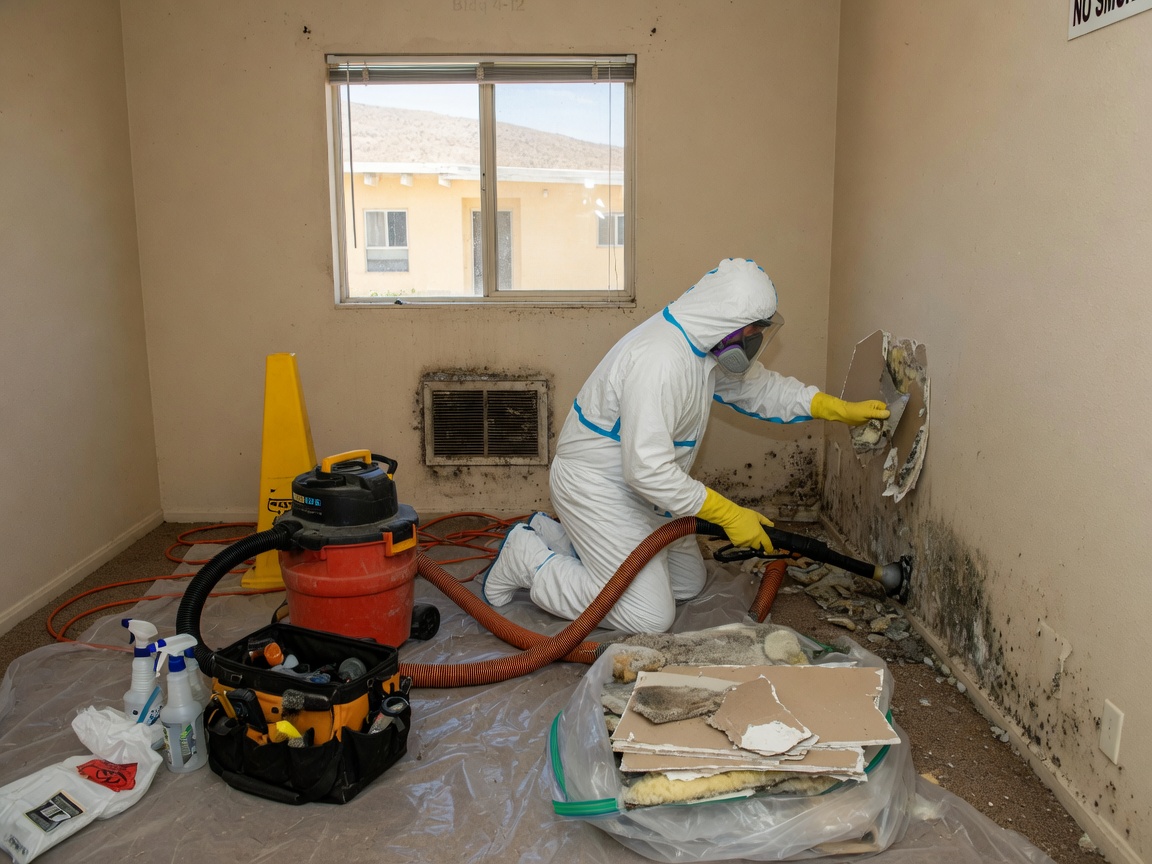
Fort Irwin's hot desert climate drives heavy air conditioning use in base housing, creating condensation behind walls and in attics that feeds mold on drywall and insulation. Older family quarters near the National Training Center often have single-pane windows and limited ventilation, allowing moisture to linger after even minor leaks from pipes or roofs. Technicians must open cavities carefully to avoid spreading spores into living spaces while working around tight military schedules and restricted access areas.
San Bernardino County building codes require proper containment and HEPA filtration during remediation to protect occupants, especially in multi-unit housing common around Fort Irwin. Cold winter nights cause rapid temperature drops that push warm, moist air into cooler wall spaces, worsening hidden colonies. Materials like paper-faced drywall and carpet padding trap spores quickly, so removal often extends beyond visible stains to prevent regrowth once temperatures swing again.
Edge cases include mold in HVAC systems serving the Fort Irwin Museum buildings and nearby Barstow-adjacent properties, where dust from the desert combines with moisture to create persistent issues. Technicians test surfaces with moisture meters before sealing and always verify that the source leak is fixed first, since desert heat can mask ongoing problems until the next cold snap.
Post-remediation, air scrubbing and dehumidification run until readings drop below 50 percent relative humidity, a critical step in Fort Irwin where summer highs above 100 degrees can restart cycles if any dampness remains.
Technician insight
In Fort Irwin the thing that catches most people out with Mold Remediation is condensation forming inside wall cavities during the big summer-to-winter swings; the military housing stock around the National Training Center has thin insulation so even a small pipe drip can hide growth until the AC kicks on again.
Hidden Growth in Family Quarters Near 3rd Street
A Fort Irwin resident noticed musty odors in a bathroom after a minor roof leak during summer heat. Inspection revealed mold behind drywall in the wall shared with the attic. Crews contained the space, removed the affected sections, treated the framing, and ran dehumidifiers until readings normalized, allowing the family to return without further issues.
Mold Remediation Services We Offer
✓Black Mold Removal
Full containment and removal of Stachybotrys from affected drywall and insulation in Fort Irwin base housing where poor ventilation allows colonies to spread.
✓Attic Mold Remediation
Inspection and treatment of mold growth in attics caused by roof leaks and extreme temperature swings between hot days and cold desert nights.
✓HVAC Mold Remediation
Cleaning and sanitizing ductwork and coils in military family quarters where AC condensation combines with desert dust to foster hidden mold.
✓Drywall Mold Remediation
Targeted removal of contaminated drywall sections in kitchens and bathrooms, followed by antimicrobial treatment to stop regrowth in older Fort Irwin structures.
✓Crawlspace Mold Treatment
Moisture control and mold removal beneath homes near the National Training Center, addressing soil vapor and poor grading common in San Bernardino County housing.
Mold Remediation Cost in CA
| Service | Typical Range | What Affects It |
|---|---|---|
| Small bathroom or closet remediation | $600–$1,200 | Increases with hidden wall cavity work |
| Attic mold treatment | $900–$2,500 | Higher when insulation removal is needed |
| HVAC system cleaning | $400–$900 | Varies by number of ducts in older quarters |
| Full room drywall replacement | $1,500–$3,500 | Driven by square footage and disposal fees |
Ranges are typical for CA and confirmed with an exact written quote before any work starts.
How it works
- 1
Initial Assessment
Technicians inspect affected areas in Fort Irwin homes using moisture meters and borescopes to locate hidden growth behind walls without disturbing spores.
- 2
Containment Setup
Plastic barriers and negative air machines isolate the work zone to prevent cross-contamination in multi-unit base housing.
- 3
Removal and Cleaning
Contaminated materials are removed, surfaces are HEPA-vacuumed and treated with EPA-approved antimicrobials suited for desert conditions.
- 4
Drying and Verification
Dehumidifiers run until humidity stabilizes, followed by post-remediation testing to confirm levels safe for reoccupancy.
Pricing
Costs depend on the size of affected areas, accessibility in base housing, and whether HVAC components require cleaning.