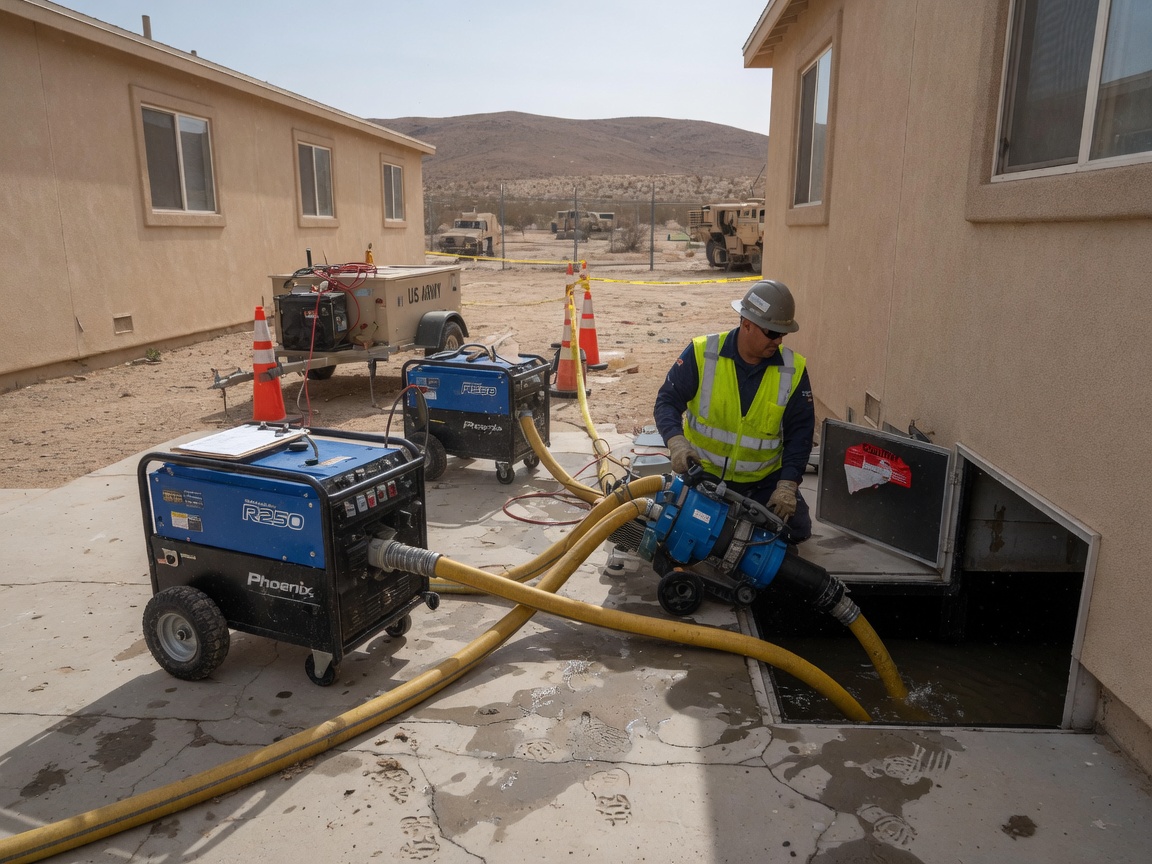
Fort Irwin homes sit on concrete slabs or raised foundations in San Bernardino County, where a burst supply line or washing machine failure can push water under cabinets and into subfloor voids within minutes. In summer heat above 100 degrees, standing water evaporates quickly on the surface but traps moisture against cooler slab edges, creating hidden pockets that later feed mold once winter nights drop below freezing. Extraction crews must pull baseboards and use moisture meters on drywall seams early, because the dry desert air masks the real saturation depth.
Military base housing stock in Fort Irwin often features vinyl plank or carpet over particleboard underlayment installed in the 1990s and 2000s. These materials wick water laterally faster than older hardwood, so technicians cut perimeter channels and apply negative pressure before the water reaches the National Training Center side of post. Cold winter nights slow evaporation, requiring longer dehumidifier run times than jobs in nearby Barstow where daytime swings are less extreme.
Technicians check for hidden voids around plumbing penetrations common in Fort Irwin duplexes and single-family units. They document saturation with thermal imaging because the extreme diurnal temperature range can make infrared readings misleading if taken only during peak heat. Extraction stops only after repeated meter checks confirm subfloor moisture matches ambient levels recorded at Bldg 350, 3rd St.
Edge cases include water that travels under vinyl sheet flooring installed wall-to-wall; pulling it intact risks tearing and spreading contaminants. Crews instead slice relief cuts, extract from below, then reinstall with new seam tape once drying is complete.
Technician insight
In Fort Irwin, the thing that catches most people out with Residential Water Extraction is how fast water travels under vinyl plank or carpet pad on particleboard during a 110-degree summer day, then hides along the cooler slab edge until winter nights drop and mold starts. Homeowners often stop at surface extraction and miss the lateral spread common in base housing built on this desert terrain.
Washing Machine Leak In Base Housing
Water from a failed supply hose reached the laundry room slab edge and traveled under adjacent vinyl plank. Meters showed saturation extending four feet into the living area. Crews cut perimeter channels, extracted from below the underlayment, and ran drying equipment through the cold night until readings matched ambient levels. Flooring was reinstalled after verification.
Residential Water Extraction Services We Offer
✓Carpet and Pad Extraction
Remove saturated carpet and underlying pad, then extract trapped water from the subfloor before reinstall or replacement.
✓Hardwood Floor Drying
Pull baseboards, insert air movers under planks, and monitor moisture content to prevent cupping in Fort Irwin's rapid humidity swings.
✓Slab Edge Water Removal
Target water that migrates under slab edges in concrete-foundation homes common on post, using perimeter channels and negative pressure.
✓Appliance Leak Extraction
Contain and extract water from refrigerator, washer, or water heater failures before it reaches adjacent rooms in base housing.
✓Drywall and Baseboard Extraction
Cut and remove water-damaged lower drywall and baseboards to stop wicking in walls exposed to desert temperature extremes.
✓Subfloor Moisture Mapping
Use meters and thermal imaging to locate hidden saturation in particleboard underlayment typical of 1990s–2000s Fort Irwin units.
Residential Water Extraction Cost in CA
| Service | Typical Range | What Affects It |
|---|---|---|
| Initial Assessment And Mapping | Free | During listed business hours at Bldg 350, 3rd St |
| Carpet And Pad Extraction | $250–$650 | Varies with room size and pad thickness |
| Slab Edge Or Subfloor Extraction | $400–$900 | Higher when multiple rooms or underlayment removal required |
| Daily Equipment Monitoring | $150–$300 per day | Depends on number of machines and duration needed for desert drying conditions |
Ranges are typical for CA and confirmed with an exact written quote before any work starts.
How it works
- 1
On-Site Assessment
Arrive within the posted hours, document visible water, and map saturation using meters and imaging.
- 2
Water Extraction
Deploy truck-mounted and portable extractors to pull standing and trapped water from carpets, pads, and subfloors.
- 3
Containment And Drying Setup
Install air movers, dehumidifiers, and barriers to control airflow while protecting unaffected areas.
- 4
Moisture Verification
Re-check readings daily until materials reach ambient levels recorded at the Fort Irwin site.
- 5
Final Walkthrough
Confirm all extracted areas are dry and ready for restoration or repairs.
Pricing
Upfront quotes after inspection; final cost depends on square footage, water depth, and materials affected.